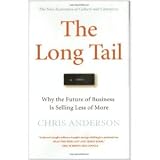
The Long Tail: Why the Future of Business is Selling Less of More by Hyperion
List Price : $24.95
Price Save :
SalesRank :805025
Warranty:
LowestNewPrice: $0.85
LowestUsedPrice: $0.99


Wired editor Anderson declares the death of "common culture"—and insists that it's for the best. Why don't we all watch the same TV shows, like we used to? Because not long ago, "we had fewer alternatives to compete for our screen attention," he writes. Smash hits have existed largely because of scarcity: with a finite number of bookstore shelves and theaters and Wal-Mart CD racks, "it's only sensible to fill them with the titles that will sell best." Today, Web sites and online retailers offer seemingly infinite inventory, and the result is the "shattering of the mainstream into a zillion different cultural shards." These "countless niches" are market opportunities for those who cast a wide net and de-emphasize the search for blockbusters. It's a provocative analysis and almost certainly on target—though Anderson's assurances that these principles are equally applicable outside the media and entertainment industries are not entirely convincing. The book overuses its examples from Google, Rhapsody, iTunes, Amazon, Netflix and eBay, and it doesn't help that most of the charts of "Long Tail" curves look the same. But Anderson manages to explain a murky trend in clear language, giving entrepreneurs and the rest of us plenty to think about. (July) Copyright © Reed Business Information, a division of Reed Elsevier Inc. All rights reserved.
Read more The Long Tail: Why the Future of Business is Selling Less of More
The Long Tail: Why the Future of Business is Selling Less of More Feature
See More available at external websites.
What happens when the bottlenecks that stand between supply and demand in our culture go away and everything becomes available to everyone?
"The Long Tail" is a powerful new force in our economy: the rise of the niche. As the cost of reaching consumers drops dramatically, our markets are shifting from a one-size-fits-all model of mass appeal to one of unlimited variety for unique tastes. From supermarket shelves to advertising agencies, the ability to offer vast choice is changing everything, and causing us to rethink where our markets lie and how to get to them. Unlimited selection is revealing truths about what consumers want and how they want to get it, from DVDs at Netflix to songs on iTunes to advertising on Google.
However, this is not just a virtue of online marketplaces; it is an example of an entirely new economic model for business, one that is just beginning to show its power. After a century of obsessing over the few products at the head of the demand curve, the new economics of distribution allow us to turn our focus to the many more products in the tail, which collectively can create a new market as big as the one we already know.
The Long Tail is really about the economics of abundance. New efficiencies in distribution, manufacturing, and marketing are essentially resetting the definition of what’s commercially viable across the board. If the 20th century was about hits, the 21st will be equally about niches.

No comments:
Post a Comment